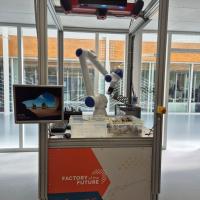
3D bin-picking is an advanced automation technique in which an industrial robot can recognize, locate, and pick unsorted parts from a bin. This technology combines cutting-edge robotics, intelligent software, high-resolution cameras, and AI-powered image processing to enable reliable object detection and handling. The vision system uses dual-laser technology, allowing it to accurately detect even reflective or shiny objects. The software-controlled robotic arm then precisely grasps the items and places them in a designated location.
With this 3D bin-picking service, companies can experiment with a wide range of parts and components based on their specific use cases. In addition, the setup can be used to create a digital twin of the entire system, including the bin, parts, robot arm, and gripper. This digital simulation environment allows the setup to be thoroughly tested, validated, and optimized before making significant investments in physical hardware.
To ensure successful testing and experimentation, customers are expected to provide the following inputs:
The results of each test or experiment are documented in an evaluation report, providing insights into performance and feasibility, and clearly indicating whether the available 3D bin-picking technology is suitable for handling the client’s parts.
This service demonstrates how advanced manufacturing technologies can be leveraged and adapted to handle a wide variety of objects and components. It highlights the practical impact of these technologies on real-world manufacturing processes, enabling users to better understand performance, flexibility, and added value in production environments.
When new or additional technologies are integrated and tested within this setup, the result is validated innovation in a real manufacturing context. This contributes to increasing the Technology Readiness Level (TRL), supporting the transition from experimental solutions to scalable, industry-ready applications.
User: manufacturing companies that operate in high-mix, low-volume settings and need flexibility in their production processes.
Do you have a question or want to get in touch with us? Please leave your details below.
Deze website gebruikt cookies ter optimalisatie van uw browsing ervaring. Lees meer over hoe de cookies worden ingezet.